

HEADMASTER'S BLOG
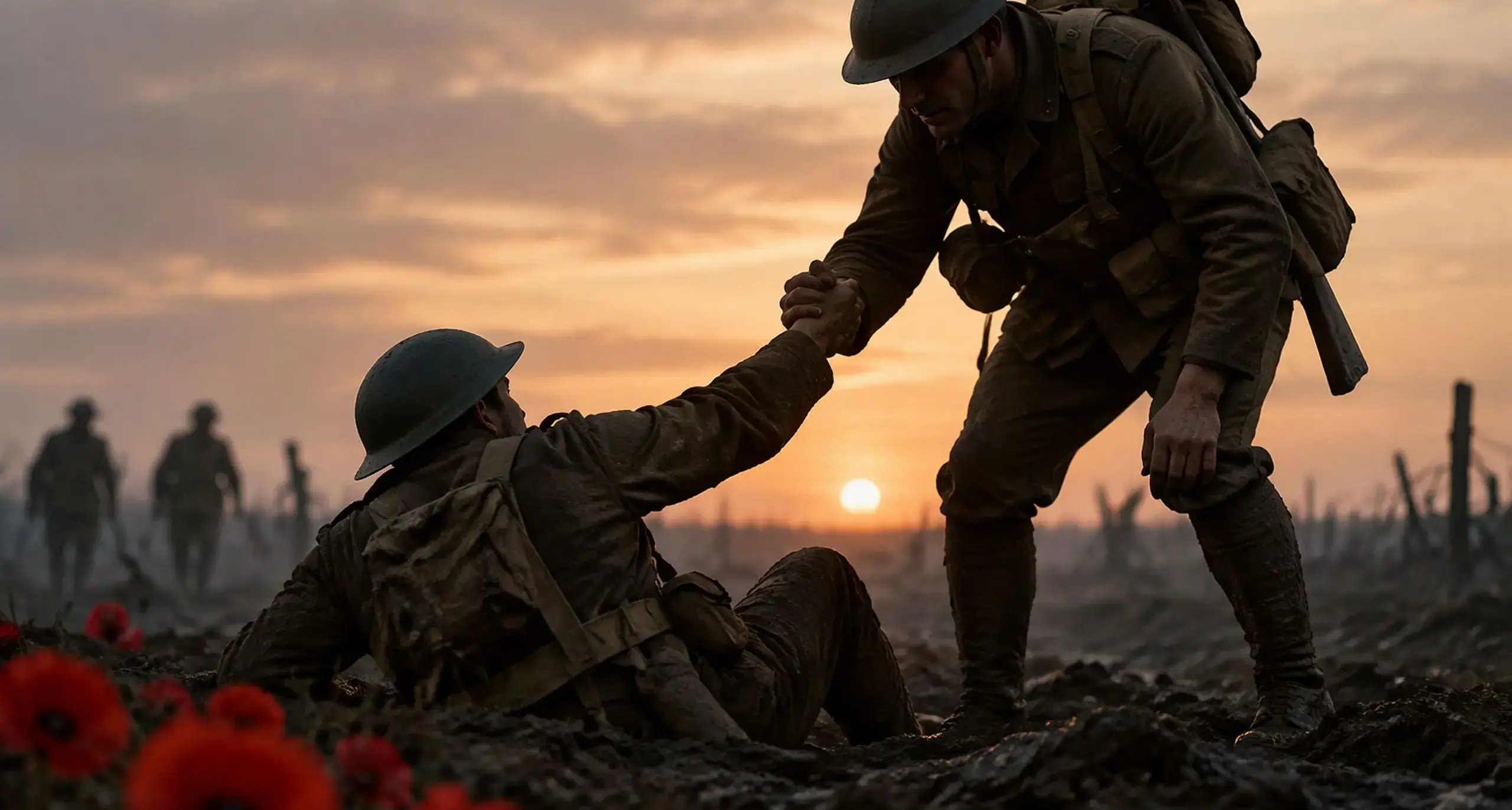
To raise the fallen
ALSO SEE
Embley is part of United Learning. United Learning comprises: UCST (Registered in England No: 2780748. Charity No. 1016538) and ULT (Registered in England No. 4439859. An Exempt Charity). Companies limited by guarantee. VAT number 834 8515 12. Registered address: United Learning, Worldwide House, Thorpe Wood, Peterborough, PE3 6SB.
HEADMASTER'S BLOG
Our community gathered at 9 o’clock on Wednesday to remember. In a space so full of memories, routinely joyous, sometimes raucous, where we celebrate significant school events and enjoy the cacophony that follows House competitions. This particular morning was different. In a crowded Sports Hall, you could hear a pin drop. The silence chaperoned the Colour Party in, and we began our Service of Remembrance. Some years ago, I had introduced the community to a fallen soldier of the first war; his great grandson later contacted me and shared his story, some photos of family, medals and his service notes which all brought to life a life cut short a long time ago. But in the sharing, something of that fallen soldier persisted and lived on in memory. I introduced the community to another fallen hero on Wednesday, but not a combatant.
Father W Doyle was an Irish Jesuit priest appointed in November 1915 to the 16th Division of the Royal Irish Fusiliers. This was an interesting move not spiritually, the response to the call to serve would have been routine for him, but the Irish had an interesting political position in the early 20th Century, the complexity of which is not for this space. Suffice to say that he exemplified the call to serve that is the theme for this year’s Remembrance. I shared with the community some stories taken from a collection of his letters to his father back in Dublin. In one, he rejoiced in the arrival of a plum pudding from his sister-in-law only to write several days later that a rat had set up home in the pudding, devouring most of it but making “the remainder all the sweeter”. I am not so sure that I would have the stomach to share the pudding regardless of its taste.
Father Doyle was and is subsequently widely regarded for his upbeat nature, his optimism and courage. He routinely ran amid open fire to minister to the fallen; he made no distinctions in the face of need and seems to have commanded a huge respect form the soldiers because of this. But in a letter of 21 December 1916, he comments after a Commander had praised these qualities that “Thank God, I have been able to conceal my feelings and so to help others to despise the danger when I was just longing to take to my heels… my real feeling was one of abject fear and I often shook like a leaf.” Saintliness may involve being unworldly while living in the world, it is not being super-human and Doyle was all too human. He saw conflict at the Somme and Messines Ridge and on a mission to rescue wounded colleagues was killed in action at Passchendaele on 16 August 1917.
Doyle’s story is one of many, perhaps exceptional in its motivation, utterly selfless and in the service of the Divine. He commented in a letter of 1 January 1917 about the voices at home who called for “no peace at any price.” He noted that this call came from those who would never experience the waiting, the bombardments, the theatre of war themselves; he calls on both sides to consider “peace at any price.”
On Wednesday, we didn’t get into the well-rehearsed arguments about policy, instead we thought to consider what Remembrance obliges us to do. Remembering invites us to action, to do something. So, I invited the community to consider Peace. Not in a vacuous sterile somnambulant numbness to life. An analgesia to the vicissitudes it brings is not Peace at all. Being in right relationship with oneself and others, understanding our purpose, it is this reconciliation that brings Peace.
Remembrance invites us to join a wider community through space and time, to hold in our minds all those who have gone before us, those who have made the ultimate sacrifice, the better that they do not grow old. That for our tomorrow they gave their today. We flourish because of their laying down their lives for friends they never knew. Isn’t it appropriate that we advocate for Peace? How might we bring it about? What role should we play? As we get up from our Service, what one step might we take toward Peace? Is there something to be said for beginning the reconciliation with ourselves? Asking for forgiveness as we forgive those who trespass against us? Asking how might I serve not what do I want? In this, we raise the fallen.

Our community gathered at 9 o’clock on Wednesday to remember. In a space so full of memories, routinely joyous, sometimes raucous, where we celebrate significant school events and enjoy the cacophony that follows House competitions.

Winnie the Pooh is a hundred. I wonder if your experience of him is as a wonder ancient and new. There is a timelessness to the stories and adventures that appeals to generation after generation of children.